Every second. Every crew. Always connected.
Instant, encrypted communications for ambulance, fire and rescue crews and control rooms
- Encrypted voice
- Live GPS
- SOS & man-down
- Nearest-unit dispatch
- Call playback
Built for
- Ambulance & EMS
- Fire & rescue
- Private response
- Event medical
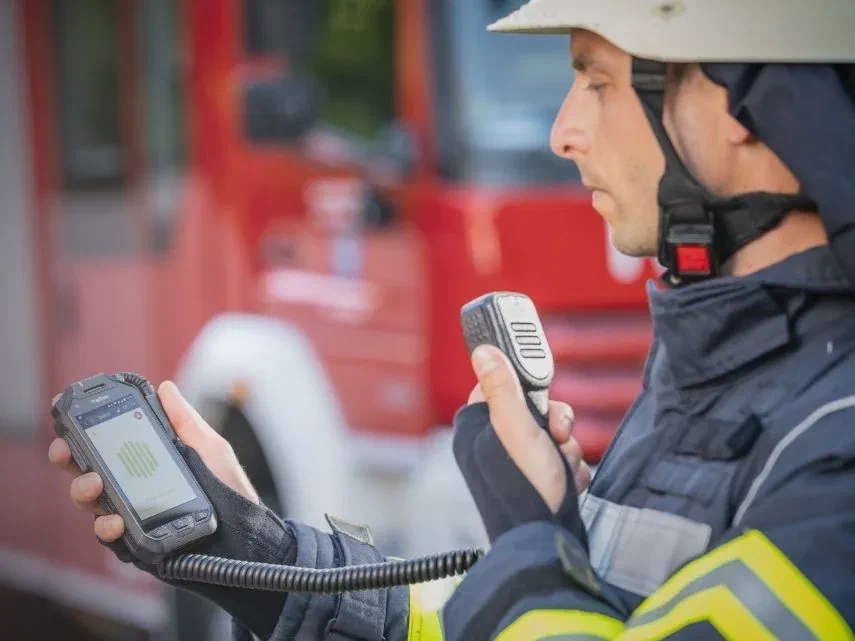
Faster response, safer crews on every call
Instant communications for the moments emergency response is most at risk
Emergency crews are judged in minutes. The nearest unit has to be found, briefed and moving at once, and the control room has to follow every vehicle until the patient is handed over. On scene, responders face crowds, traffic, fire and violence, and they need one button to get help or bring in backup.
Where response operations are exposed
| Risk point | What goes wrong today | How Tactiron responds |
|---|---|---|
| Slow dispatch | Calls relayed by phone, one crew at a time | One press reaches the nearest crew, a whole area or every unit at once |
| Unknown unit location | Control room guesses which ambulance is closest | Live GPS map of every vehicle and responder, updated in real time |
| Responder in danger | Crew member assaulted or injured on scene with no quick way to call | One-touch SOS and automatic man-down send voice and location together |
| Radio dead zones | VHF/UHF fails between towns, in basements or dense housing | Works over any mobile network or Wi-Fi, with a digital mobile radio (DMR) add-on for no-signal areas |
| Multi-agency incidents | Ambulance, fire, police and security on separate systems | Temporary shared talk groups for joint incidents, set up in seconds |
| Incident review | No record of what was said, when or where | Call playback, GPS history and trip reports for clinical audit and insurers |
One channel for crew, vehicle and control room
Handhelds, ambulance and fire-appliance terminals and the desktop dispatcher share encrypted talk groups. Dispatchers reach one crew, one station or every unit, and track every vehicle and responder on one map. AES-256 encryption keeps patient details and incident locations private.
An emergency call, step by step
What the crew and control room see at each stage
| Stage | Crew | Control room |
|---|---|---|
| Shift start | Crew checks in on the handheld; near-field communication (NFC) tag in the vehicle confirms crew and unit | Units appear live on the map, grouped by station and talk group |
| Dispatch | Call received by group or private push-to-talk (PTT); acknowledged with one press | Dispatcher picks the nearest free unit from the live map and briefs it by voice |
| En route | Driver talks hands-free through the in-vehicle terminal | Live tracking; reroute or reassign as the situation changes |
| On scene | Remote speaker or earpiece keeps hands free; SOS and man-down active | Can listen in on alert; backup called by group PTT |
| Major incident | Crew joins a shared talk group with fire, police and security | Dispatcher patches all agencies into one temporary group |
| Handover & close | Hospital handover confirmed by PTT; NFC scan at the facility | Full call record: route, timings and voice playback for audit |
Cellular PTT vs conventional radio for responders
| Feature | Cellular PTT | Conventional VHF/UHF radio |
|---|---|---|
| Range | Works wherever mobile data is available, in the city or on the highway | Depends on terrain, antennas and repeaters |
| Dispatch visibility | Live GPS map, geofencing and trip reports built in | Usually voice only |
| Responder safety | SOS, man-down and listen-in on every device | Varies by model |
| Security | Encrypted voice and central user management | Analogue is easily scanned; encryption varies by model |
| Resilience | A digital mobile radio (DMR) add-on lets crews talk directly to each other when there is no signal | Works without a network, but each site needs assessing first |
| Scaling | Add a unit or station in minutes; no masts to build | Infrastructure, licensing and support |
Every type of emergency service on one platform
Configured for each kind of responder
-
Ambulance & EMS
Nearest-unit dispatch, hospital handover by PTT and a full record of every call.
-
Fire & rescue
Loud-scene audio, rugged IP68 handhelds and off-network radio inside buildings.
-
Private emergency response
Armed and medical response units tracked live, with SOS for every officer.
-
Event & venue medical cover
Temporary talk groups for stadiums, concerts and marathons, set up per event.
-
Disaster & humanitarian teams
One system and the same talk groups across every country you operate in.
-
Hospital & patient transport
Coordinate transfers between facilities and see every vehicle on one map.
Deployment & support
-
Rollout planned around your stations, vehicles and shift patterns, with installation coordinated per vehicle.
-
Talk groups set up to match your stations, areas and mutual-aid partners.
-
Crew and control-room training: calling, talk groups, SOS, man-down, dispatch and multi-agency groups.
-
Local technical and warranty support.
Why responders switch
-
Faster dispatch: the nearest unit is found and briefed in one press.
-
Safer crews: every responder can raise the alarm, even if they cannot speak.
-
Better records: every call, route and timing is kept for audit and training.